A breast self-exam is a simple way to become familiar with how your breasts normally look and feel so you can notice changes more quickly. Major cancer and hospital resources describe it as part of breast self-awareness, not a replacement for mammograms or professional screening.
That distinction matters. A self-exam can help you spot a new lump, nipple discharge, skin dimpling, swelling, or other unusual changes, but it should work alongside regular medical care and age-appropriate screening.
Why self-exams matter
The main purpose of a breast self-exam is familiarity. Cleveland Clinic explains that monthly self-exams can help you detect changes, while Breastcancer.org emphasizes getting to know your breasts so you can recognize what is different from your normal baseline.
A self-exam does not diagnose breast cancer on its own. Instead, it helps you notice something that may need medical evaluation, especially if a change is new, persistent, or clearly different from your usual breast tissue.
This is especially useful because breasts are not perfectly symmetrical and their texture can shift with menstrual cycles, hormones, age, pregnancy, breastfeeding, or menopause. The goal is not to find perfection. The goal is to notice a meaningful change.
When to do it
Many breast health resources suggest checking your breasts about once a month so the process becomes routine and you learn your normal pattern over time. Cleveland Clinic and the National Breast Cancer Foundation both describe monthly self-exams as a practical rhythm.
If you menstruate, it is generally best to examine your breasts a few days after your period ends, when breasts are often less swollen or tender. Mayo Clinic advises choosing a consistent time each month, and if you no longer have periods, selecting the same date monthly can make the habit easier to maintain.
What matters most is consistency. Doing it randomly every few months makes it harder to remember what is normal for you and easier to overreact to temporary changes.
Step 1: Look in the mirror
Start with a visual exam in front of a mirror with your shirt and bra removed. Cleveland Clinic says to first look with your arms relaxed at your sides, checking for changes in breast shape, swelling, dimpling of the skin, or changes in nipple position.
Next, raise your arms above your head and look again for the same kinds of changes. Then place your hands on your hips and press firmly to tighten your chest muscles, which can make subtle contour changes easier to see.
As you look, pay attention to:
- New swelling or visible distortion.
- Dimpling, puckering, or skin that looks like an orange peel.
- Redness, rash, or scaliness on the breast or nipple.
- A nipple that has newly turned inward or changed position.
- Any fluid leaking from the nipple.
Do not expect both breasts to look identical. The National Breast Cancer Foundation notes that few women’s breasts are perfectly symmetrical, so the important issue is not small natural differences but a new or unusual change.
Step 2: Feel your breasts standing or in the shower
Many people find it easiest to do the next part in the shower because wet, soapy skin allows fingers to move more smoothly. The National Breast Cancer Foundation recommends using the pads or flats of your three middle fingers to check the entire breast and armpit area.
Use your right hand to examine your left breast and your left hand to examine your right breast. Apply light pressure first, then medium pressure, then firm pressure so you can feel tissue at different depths. Cleveland Clinic and other breast health guides consistently recommend this three-level pressure method.
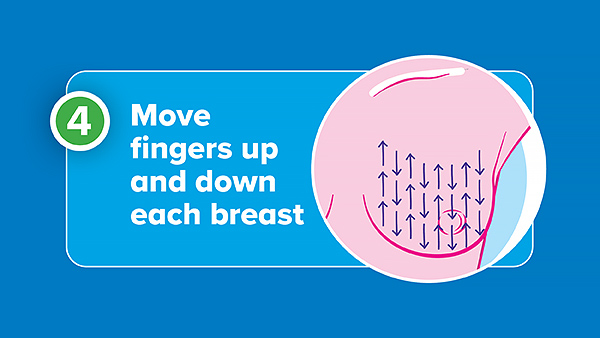
Move your fingers in a consistent pattern so you do not miss any area. Some sources recommend circles that grow outward from the nipple, while others prefer an up-and-down vertical pattern like mowing a lawn. Both are acceptable as long as you cover the full area from collarbone to upper abdomen and from armpit to cleavage.
Be sure to examine:
- The full breast, not just the center.
- The area under the arm, because breast tissue extends toward the armpit.
- The areola and nipple area.
- Any area that feels newly thickened, harder, or different from the surrounding tissue.
Some guides also advise gently squeezing the nipple to check for discharge. If discharge appears without squeezing, or if it is bloody or only from one side, it should be reported promptly.
Step 3: Feel your breasts lying down
Lying down spreads the breast tissue more evenly over the chest wall, which can make changes easier to feel. Cleveland Clinic and the National Breast Cancer Foundation both recommend placing a pillow under the shoulder on the side being examined and putting that arm behind your head.
For example, to examine your right breast, place a pillow under your right shoulder and put your right arm behind your head. Then use the pads of the three middle fingers of your left hand to examine the entire right breast and armpit using light, medium, and firm pressure.
Again, use a pattern and cover the whole area. Breastcancer.org describes moving in circles from the nipple outward or using straight vertical rows from collarbone to abdomen and from armpit to cleavage. Memorial Sloan Kettering also describes the vertical up-and-down approach across the whole breast until you reach the breastbone.
Repeat the same process on the other side. The most important thing is not whether you choose circles or rows, but whether you examine every part of the breast in a regular, repeatable way.
What to look and feel for
A breast self-exam is not only about finding a lump. Several major sources say you should also watch for visible and physical changes that may not feel like a round mass.
Look or feel for:
- A new lump or hardened knot.
- Thickening in one area that feels different from nearby tissue.
- Swelling, even without a distinct lump.
- Dimpling or puckering of the skin.
- Nipple inversion, crusting, rash, or scaling.
- Nipple discharge, especially if spontaneous or one-sided.
- Persistent pain in one area that is unusual for you.
Not every change means cancer. Many breast changes are caused by benign cysts, hormonal fluctuations, infections, or other noncancerous conditions, but a new change still deserves medical attention.
Common mistakes to avoid
One of the biggest mistakes is pressing only lightly. Cleveland Clinic and other sources recommend light, medium, and firm pressure because different tissue layers can reveal different changes.
Another common mistake is checking only the obvious center of the breast. Breast tissue reaches toward the armpit and across a broader area than many people realize, so limiting the exam to the nipple area can cause you to miss a change.
A third mistake is using no pattern at all. Random touching can leave gaps, which is why experts suggest a repeatable circular or vertical method that covers the same territory every time.
Many people also compare their breasts too literally and worry because one side is slightly larger or shaped differently. The National Breast Cancer Foundation notes that asymmetry is common, so focus on new changes rather than natural differences between left and right.
Another mistake is panicking over every lumpy texture. Breasts often contain normal glandular tissue that can feel uneven, especially during hormonal shifts, so what matters most is a change that is new, persistent, or clearly different from your usual pattern.
It is also a mistake to treat a self-exam as a substitute for screening. Mayo Clinic specifically frames breast self-exam as a self-awareness tool, not a replacement for mammograms or professional evaluation.
Finally, many people wait too long after noticing something unusual. A self-exam only helps if it leads to follow-up when needed. If you notice a new lump, skin dimpling, nipple discharge, or another concerning change, the right next step is to contact a healthcare professional.
When to call a doctor
You should seek medical advice if you notice a new lump, persistent thickening, swelling, dimpling, a nipple that suddenly turns inward, unusual discharge, or a skin change that does not go away. These signs do not automatically mean cancer, but they do warrant proper evaluation.
It is also worth calling if you are unsure whether something is new. Doctors and breast imaging specialists would rather evaluate a questionable change than have someone delay care because they were afraid of overreacting.
Making the habit easier
The easiest way to make breast self-exams useful is to keep them simple and consistent. Pick one time each month, use the same sequence each time, and focus on learning your baseline rather than trying to perform a perfect medical procedure.
A practical routine looks like this:
- Look in the mirror with arms at sides, overhead, and hands on hips.
- Feel each breast and armpit standing or in the shower using three-finger pads and three levels of pressure.
- Repeat the exam lying down with a pillow under your shoulder and a clear pattern across the full breast.
The real value of a breast self-exam is not speed. It is awareness. When you know what is normal for your body, you are in a much stronger position to notice what is not.